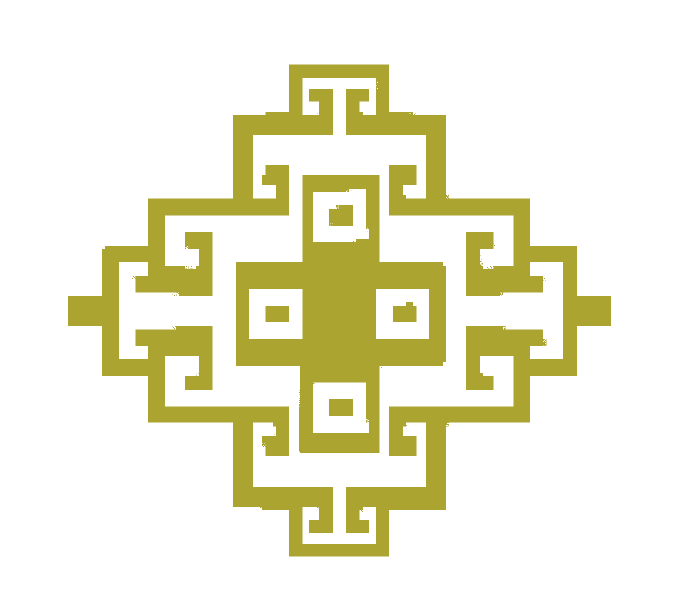
Chakana Pendant – Serpentine with Cord
Code: 2550Product detailed description
Chakana is the most important symbol of Andean culture. According to tradition, it represents a concept that has several levels of meaning and complexity depending on how it is used and interpreted.
Chakana, also known as “chaka hanan”, means “bridge to the summit”. It is also associated with the constellation of the Southern Cross and represents a synthesis of the Andean worldview. It connects astronomy with the seasons and reflects the entire Andean system – spiritual, religious, and philosophical.
Chakana, understood as a bridge or crossing, appears at the intersection of lines drawn from top to bottom – vertically – and from left to right – horizontally. This creates two “sacred spaces” that are opposite yet complementary.
The first, vertical projection, is according to traditional interpretation divided into a male and a female half. The second, horizontal projection, is divided into a half of “celestial beings” and a half of “earthly and underworld beings”. The orientation from top to bottom is associated with masculine connotations, while the orientation from bottom to top is associated with feminine connotations.
Chakana has the shape of an X, and its diagonals connect the four corners of the “house”, that is, the universe. Chakana is an Andean symbol of the connection of the whole. The space above the horizontal line represents Hanaq Pacha – the world above, the “upper layer”. The space below the horizontal line represents Kay Pacha – this world. The communication channels between these worlds are, according to Andean tradition, springs, lagoons, and mountains.
In the Andean concept, there are many relationships of correspondence and complementarity – for example between ceiling and floor, sun and fire, day and night, man and woman. These relationships indicate the direction to follow and remind us of the balance between the different parts of the world.
Country of origin: Peru
Importer: Malvarenaco CZ s.r.o.
Overview of Andean Ceremonies
| Approximate date | Ceremony | Aymara Name | Description |
|---|---|---|---|
| 21.06. | Great festival of the Sun god | Willka Hatch Laimi | Festival of the Sun. Solar New Year. In Quechua Inti Raymi, in Aymara Machaq Mara. The greatest distance between the Sun and the Earth. Symbolizes the eternal union of the Sun and human beings. |
| 01.08. | Worship of Pachamama | Wilancha | The Wilancha ceremony is performed to ask permission from Pachamama (Mother Earth) to work the land and begin sowing. According to Andean tradition, Pachamama awakens during this time. |
| 22.09. | Request for a good harvest | Auti Willka Chika | Ceremony of omens and wishes for a good harvest. |
| 02.11. | Veneration of the deceased | Shakhatas and Hiwatas | Ceremony of respect for shakhatas and hiwatas – souls and spirits. |
| 22.12. | Return of the Sun | Willka Kuti | Mid-year. Change in the direction of the Sun. |
| 02.02. | Blessing of crops | Anatas | Today associated with carnivals. An agricultural festival during which growing crops are blessed. New animals are also marked. |
| 23.03. | Autumn equinox | Hallu Willka Chika | The time when plants reach maturity. The time to begin tasting the fruits of the harvest. A celebration of maturity. The initiation of children into adolescence begins. |
| 03.05. | Authorization for harvest | — | Day of the Chakana. The constellation of the Southern Cross takes on the astronomical form of a perfect cross, vertically aligned with the South Pole. Permission is requested from Pachamama to harvest the fruits. |
Source: pueblosoriginarios.com